About the Work
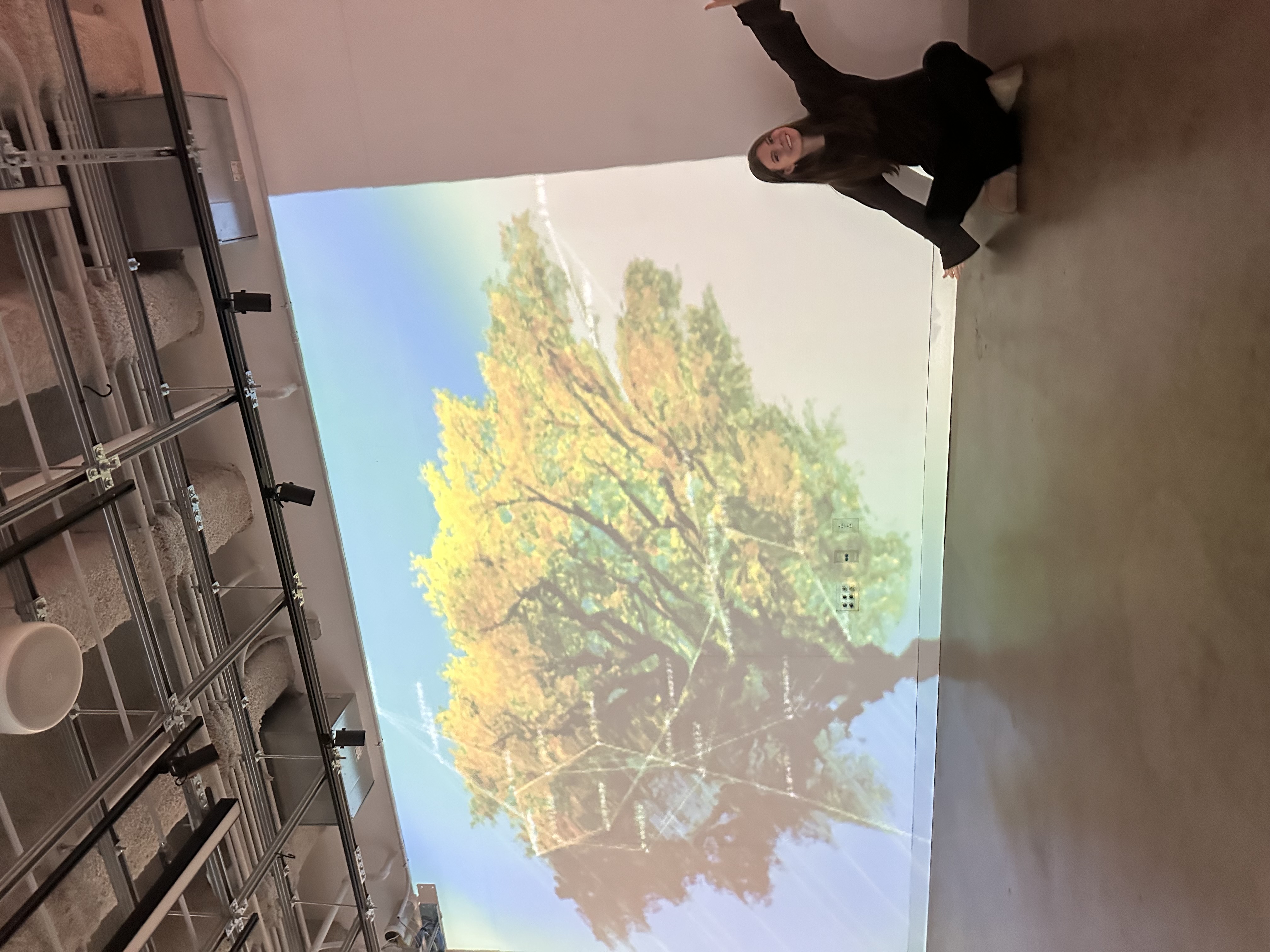
Tree of Life is an audio-reactive, generative installation that explores themes of life, growth, and interconnectedness through light, motion, and sound. Designed as a projection-mapped experience, the piece transforms a static tree into a living system that responds to music.
In my childhood home, my family had a beautiful, grand Elm tree that I used to play under a lot as a kid. I chose an Elm tree as the foundation of this piece since it reminded me of youth, family, and stability. However, upon research, I discovered that the Elm tree is a prominent symbol across many cultures, and can be associated with life, strength, and resilience. It is associated with life in many cultures because the tree can survive in various conditions and can be viewed as a metaphor for spiritual growth. Although my faith was the foundation for this installation, it is not meant to be observed as a religious piece. Instead, I wanted to create something that anyone could connect with.
I titled this piece “Tree of Life” because it is a universal symbol, with significant meaning in most religions and cultures. My goal in creating this piece is that people could find their own meaning and appreciation.
I wanted to combine different aspects of the human experience. It was important for me to include audio in some aspect, so I decided to code music to drive my visuals for this piece. I also wanted to showcase the technical aspects of this piece, so I included the data points and path in the graphics. The full piece comes together through an immersive installation that invites the audience to further interact with and reflect on it.
Process
This project began with research and experimentation. I explored projection-based installations and drew inspiration from artists like Finnbogi Pétursson and James Turrell, focusing on how light, water, sound, and space can evoke emotion. I was particularly drawn to themes of water, light, awe, and life — elements that ultimately shaped the direction of the piece.
I initially experimented with 3D modeling in Blender, Cinema 4D, and TouchDesigner, but later shifted toward manipulating a 2D rendered image to better align with my conceptual goals. After sourcing and optimizing a detailed Elm tree model, I processed and adapted it for use in TouchDesigner, carefully balancing visual complexity with performance.
At the same time, I programmed the audio component using Sonic Pi. By generating structured yet slightly randomized musical patterns, I created a soundtrack that loops seamlessly while still introducing variation. This audio directly drives the visual system, mapping amplitude and frequency data to movement, distortion, and color shifts across the tree in real time.
To further emphasize the technical layer of the work, I visualized underlying motion data through magenta tracking squares that appear across the surface at each frame. This element reveals the system behind the visuals, reflecting my interest in using technology not just as a tool, but as a visible part of the artistic experience.
The final system runs continuously, evolving over time with subtle variation driven by the generative audio, ensuring that no two moments are exactly the same.